
Training an Older Dog: Is it Possible?
Many dog owners wonder if training an older dog—especially for hunting dog training—is still possible. The truth is most adult dogs, even at 3 years old or older, can still learn the skills needed to become reliable hunting partners.
In this case study, you’ll see how Cody Lloyd took his 3-year-old retriever, Bo, and transformed him into a confident, steady hunting dog using a clear structure and consistent training plan. Cody’s experience proves that it’s not too late to start training an older dog and that your dog may be more capable than you think.
Case Study: How Cody Trained His 3-Year-Old Retriever and Turned Him Into a Reliable Hunting Dog
Cody Lloyd spent two and a half years trying to learn how to train a hunting dog. He spent his time piecing together training from YouTube videos, books, and multiple sources. His lab Bo could sit, stay, and heel- but three things plagued him.
His steadiness dropped whenever Cody stepped away, casting was nonexistent, and big honkers were out of the question. He was almost ready to accept that this was just the dog he had.
Then Cody joined Cornerstone Gundog Academy and started the Complete Retriever Package. Cody started from day one of CGA, even with an older dog. Within months, Bo was handling blind retrieves at 100 yards, staying steady while other dogs broke around him, and tackling 15-pound geese like they were nothing. The relationship between Cody and Bo transformed too—built on trust, communication, and the bond that comes from training together.
As you read this, you may still have doubts. Can an older dog be trained? The answer is yes, but understanding how to teach an old dog starts with knowing how older dog learns.
Training a dog successfully begins with a strong foundation. Whether you have an older dog or a puppy with foundational cracks, your dog won't reach its potential. The key to teaching your dog is to fill all foundational cracks in properly.
As you keep reading, you will find how Cody's training before Cornerstone caused Bo to have these foundational cracks and how to fix that problem so that you can have a gun dog like Bo.
Challenge: A patchwork of YouTube tips left gaps he didn't know existed
Cody was determined to train Bo himself. He didn't want to send his dog away to a trainer and lose that time together. So he dove into YouTube, watching everything from British method trainers to GSP upland videos, trying to stitch together a complete training program.
The problem? Three different trainers meant three different philosophies. Some used heavy collar pressure. Others used none. The videos showed finished dogs running perfect drills—never the messy middle where things go wrong.
After two and a half years, Cody had a decent dog. Bo would sit, stay, and heel reliably. But steadiness fell apart the moment Cody stepped more than two feet away. There was no casting, no angle backs, and the big 14- to 15-pound honkers? Bo couldn't pick them up.
"I was completely stuck," Cody recalls. "I almost accepted that this was just the level of dog I was going to have."
He tried everything to fix the honker problem on his own—Googled it, posted in forums, messaged other trainers. Nothing worked. And the YouTube videos that got him started had simply... stopped. The trainers moved on to other breeds or topics, leaving Cody with an incomplete education and a dog that was good but not great.
Solution: Starting fresh with a proven process—even at three years old
When Cody first heard about Cornerstone Gundog Academy, he wasn't sure the investment made sense. He spent three months talking with the CGA team, asking every question he could think of. The lifetime access finally convinced him to take the leap.
But here's what surprised everyone: Cody didn't jump into the advanced modules. He went back to basic commands. All the way back to Week 1, Day 1.
"I went through it all," he explains. "I did the sit videos, the heel videos—everything from the start. I knew there were gaps in my training. I did it all myself, I winged it all myself. I'm like, I know I'm not a great trainer."
The difference this time was seeing a real dog work through real dog training problems. Violet, the dog featured in the CGA videos, failed sometimes. She made mistakes. And Cody got to watch the trainers adapt in real time—exactly what he needed to learn. With CGA duck hunting dog training doesn't have to be complicated.
In fact, proper training is often much simpler than one might think. However, without a community, diy dog trainers spin their wheels trying to figure things out. Cody's problems before and after experiencing the Cornerstone community were night and day different.
When he hit a wall with angle backs, he jumped on a community call. The advice seemed counterintuitive: spread the bumpers out instead of pulling them in close. The very next lunch break, Cody tried it.
"Wait, he went to the correct one," Cody remembers thinking. "I just never would have thought that one little change could change the entire thing for me."
The community proved invaluable again when Cody posted about Bo's struggle with big geese. Within days, thirty members chimed in with the same advice: try it in water first. Two weeks later, Bo was carrying 15-pound honkers back to the pit like it was nothing.
Results: A duck hunting dog that performs when chaos breaks loose
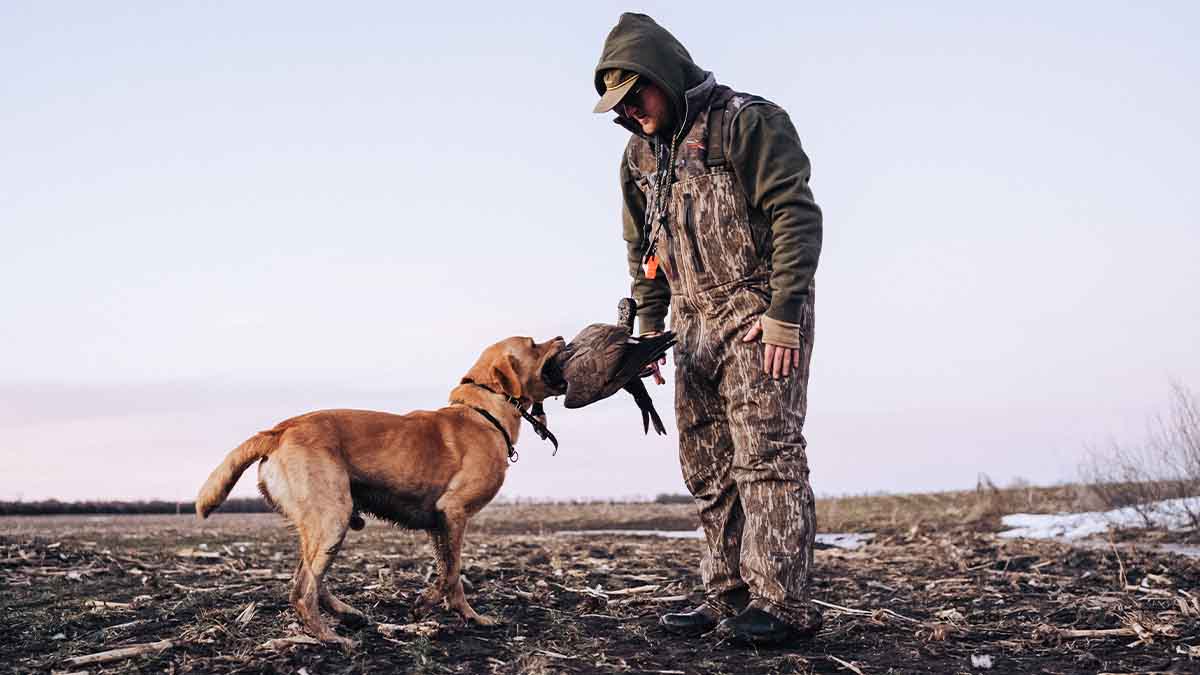
The real test came during a goose/waterfowl hunt. Four guys in a pit, two dogs, everyone shooting the breeze with heads up—not even watching the sky. A duck appeared from behind, and chaos erupted.
The other dog broke immediately, running 80 yards out to where everyone thought the bird fell. Nobody knew exactly where the duck landed except for one hunter who caught it out of the corner of his eye—way off to the right.
Bo? He sat there shaking with excitement, waiting for his name.
When the other dog couldn't find the bird, Cody sent Bo. One whistle stop at 80 yards. One cast over. Bo covered 100 yards, tackled the duck (which bit his ear the whole way back), and delivered to hand.
"All of the guys I hunt with are like, we've never seen a dog do that before," Cody says.
The 90-year-old hunter in the pit—the one who always said he doesn't like hunting with dogs because they break—made an exception. "Bo doesn't count," he told everyone. "He's a better partner to have in the blind than any normal person."
That same hunter kept a tally throughout the season: over 100 birds lost to the other dog breaking. With Bo, they limited out faster and lost fewer cripples.
Beyond the hunting results, something else changed. The relationship between Cody and Bo deepened in ways the old YouTube approach never achieved. Bo became Cody's shadow in the field—steady within five feet during two-mile walks through fog, spotting birds before anyone else, and trusting Cody completely in new situations.
- One-whistle handling on 100-yard blind retrieves
- Rock-steady while other dogs break around him
- Picks up 15-pound honkers without hesitation
- Hunted the full season off-leash with no tie-out needed
- Relationship transformed through training together
- Became the go-to dog for everyone in the pit
"I don't want to have a mediocre dog"
I was completely stuck, and I almost accepted this was just the level of dog I was going to have. He was a great dog, mostly steady—but I needed somewhere to get me over that hump. CGA definitely did it for me. Walking through the program from start to finish, coming in late with a two-and-a-half-year-old dog, it was by far the greatest change we've had.
—Cody Lloyd, Technical Writer, Pennsylvania
FAQs About Training an Older Dog
Can you train a 3-year-old dog to hunt?
Most older dogs learn quickly once you rebuild their foundation. The best place to start is with basic obedience—sit, heel, recall, and steadiness.
Many of the problems people see in older dogs, such as breaking, poor recall, or dropping birds, come from gaps in obedience training. We call these “foundational cracks,” and fixing them usually unlocks the dog’s true potential in the field.
Is 3 too old to start hunting dog training?
No. Age 3 is still an excellent age to begin hunting dog training. Older dogs often progress faster than puppies because they’re more mature, more focused, and can handle longer periods of mental stimulation. If your dog has drive and enjoys retrieving, age won’t hold them back.
How long does it take to train an older dog for hunting?
Most older dogs show noticeable improvement within a few weeks once their foundation begins to be rebuilt. A full transformation—like Bo’s—typically takes consistent work over a period of months. The timeline depends on which foundational cracks your dog has and how much training experience it already brings to the table.
If you’re not sure where your dog stands, contact us and we’ll help you figure out exactly where to begin inside Cornerstone’s Process.
Where should I start when training an older dog?
Begin with foundational obedience: sit, heel, place, recall, and steadiness. Once these are solid, you can move into marks, blind retrieves, and field concepts. Skipping ahead usually creates the same “foundational cracks” Cody experienced before joining CGA.
Can you fix bad habits in an older hunting dog?
Yes. Most bad habits—breaking, whining, dropping birds, poor recall—are symptoms of gaps in obedience or clarity. With consistent reps and a structured training program, older dogs can unlearn almost any bad habit and replace it with reliable behavior.
Can a dog with no hunting experience learn even at 2 or 3 years old?
Absolutely. Many owners start hunting dog training later in life due to schedules, life circumstances, or simply not knowing where to begin. Dogs with no early exposure can still become excellent gun dogs if you follow a proven step-by-step system.
Do older dogs need a different training plan than puppies?
The overall steps are the same, but older dogs may move through the training process faster or slower depending on their maturity, habits, and connection with you. Some older dogs pick up skills quickly because they’re more focused and emotionally settled; others may need time to replace old habits with better ones.
No matter the starting point, the best way to train an older dog is to return to the basics and work through a clear, step-by-step progression. Training isn’t age-based—it’s skill-based.
BuildFromHere,
Joshua Parvin
P.S. You can click here to pick a course and begin training your dog today.

Not Sure What To Do With Your New Puppy?
Check out some of our best advice. It's free to the new puppy owner.


